
Most of the platforms we talk to don’t have one set of bank accounts to connect. They have hundreds. An ERP implementer with 60 client companies. A bookkeeping platform with 400 businesses on it. An SMSF administrator with a fund for every client. Each of those businesses banks somewhere different, has its own account holders, and has to give its own consent before any data moves.
Superskript Aggregator is the product we built for that shape of customer. Here is how it works, in plain terms.
The idea in one sentence
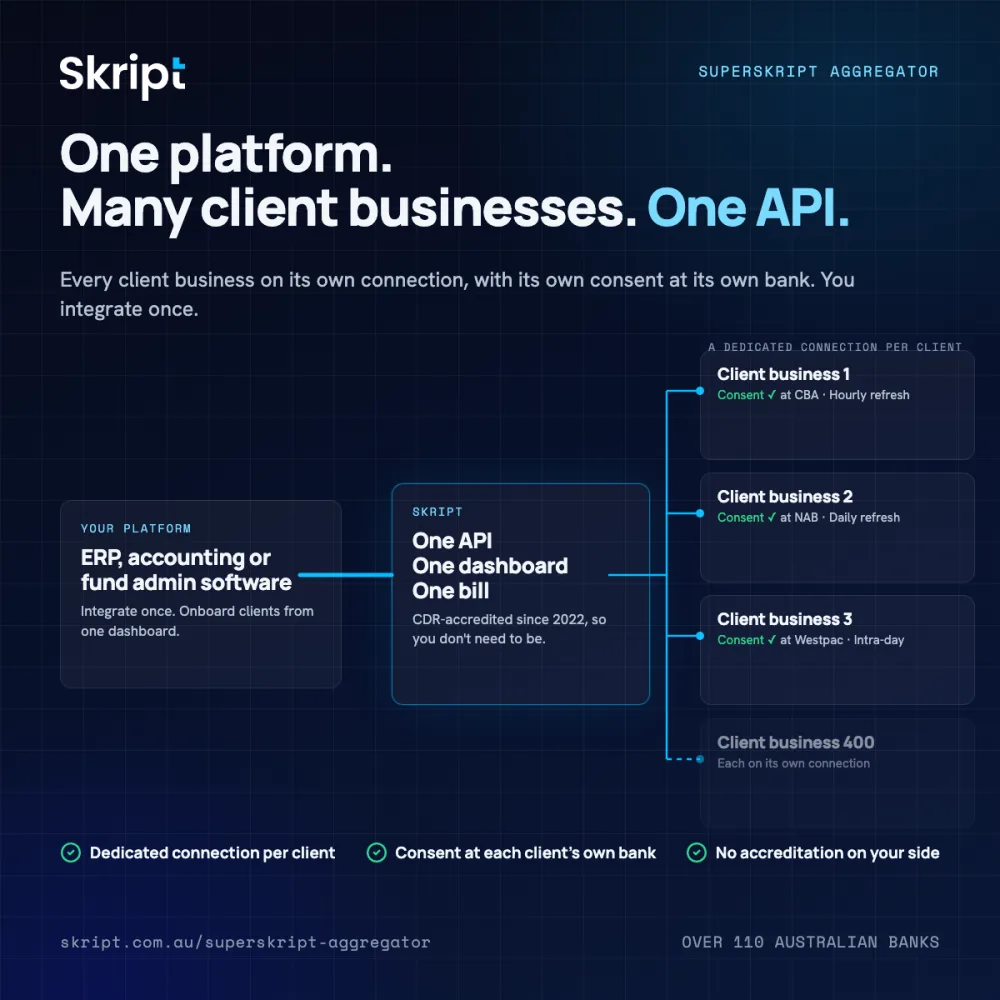
Your platform becomes the “manager” in the Skript portal. Every client business gets its own organisation under that manager, its own dedicated connection to Skript, and its own consent at its own bank. You integrate once, and each client’s data reaches you on its own connection.
Why a connection per client
Bank data for a business is sensitive, and the Consumer Data Right (CDR) treats every business as its own consumer. Keeping each client on a dedicated connection, with its own API credentials, means one client’s data is never mixed with another’s, one client’s consent never affects another’s, and if a client leaves or revokes, only that connection stops. It also lets you set the refresh rate, consent defaults and data filtering per client rather than per platform: hourly for the payments-heavy client, daily for the quiet one.
How consent works
The client business’s account holders give consent through Skript’s consent flow, at their own bank, under the CDR’s business consent rules (BCDC, or business consumer disclosure consent). That rule lets a business share its bank data with the software it uses. Skript holds the CDR accreditation; you don’t need any of your own. The flow is built for business accounts, including accounts with more than one signatory, and there is support built in to walk your client’s account holders through the steps.
What you get for each client
Transactions with descriptions, amounts, dates and, where available, categories, payees and payers. Balances. Account details including BSB and account number. Up to two years of history. Refreshed daily, five times a day or hourly, as you set for that client. Over 110 Australian banks. And when a client’s bank line is a Stripe payout, the orders behind it.
One dashboard, one bill
From the manager dashboard you create client organisations, configure their feeds and see their consent status. Billing is consolidated: one invoice to you, no per-client card collection, and no transaction caps. Superskript Aggregator starts from $2,500 a month, and we scope volumes with you. Pricing for every product is on the pricing page.
How it differs from our other products
- Subskript: a business connects its own bank accounts, for its own use. From $99 a month, self-serve.
- Superskript: your business customers’ bank data through a single API connection, when you don’t need per-client segregation. From $1,250 a month.
- Superskript Aggregator: the same data, with a dedicated connection, settings and consent per client business, and one bill to you. From $2,500 a month.
Who it’s for
Data aggregators, ERP vendors and implementers, accounting and bookkeeping platforms, SMSF and fund administrators, and business lenders reviewing business borrowers: anyone running bank feeds for many client entities under one roof. It is already in production for platforms across accounting, ERP and fund administration; see our partners page.
Getting started
We talk about volumes and your integration surface, set up your manager organisation with sandbox access, you integrate once against the API, and you onboard clients from your dashboard. Let’s talk, or read the product page first.